37.000 years Japan

from the first settlers to the 1960s

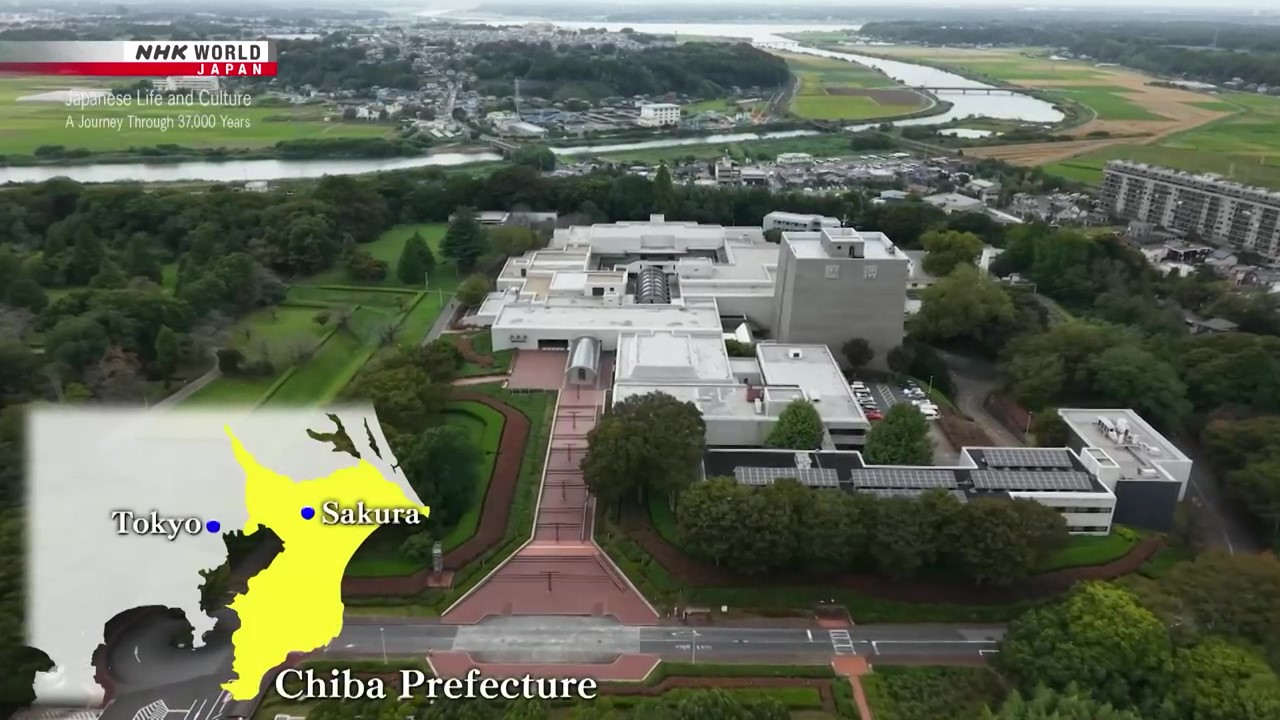
National Museum of Japanese History

The Museum

NHK World recently aired a repeat of its 2025 report on the National Museum of Japan in Sakura on its linear television channel.
Through numerous replicas and reconstructions, the museum showcases Japanese everyday culture over a period of approximately 37,000 years.
The following 12 video clips offer brief excerpts from the report.

At the end of this article, you will find the full video, 50 minutes long, packed with interesting details. The English subtitles for the Japanese-language sections are provided by NHK.

1 Prehistory

The first humans arrived on the Japanese islands approximately 37,000 years ago during an ice age. At that time, average temperatures were 10°C lower than today.

The museum brings the lives of people during this ice age to life with realistic figures.

2 Jōmon Period

As the climate became milder, people began producing pottery around 16,000 years ago.
They led a settled life as hunter-gatherers.
This period lasted for more than 10,000 years.

3 Medieval Japan

In medieval Japan, Kyoto was the capital. The emperor and the court nobility lived there. They developed a luxurious and refined culture.

The formal clothing called Juni-Hitoe was worn by the noblewomen at court. Colors, patterns, and combinations were adapted to different age groups and fragrance preferences. Playing with color gradations was a way for the nobility to appreciate the changing seasons.

4 Folding Screen Rakuchū Rakugai-zu Byōbu

This famous folding screen depicts life in 16th-century Kyoto in numerous details. It consists of two panels, representing the western and eastern parts of the capital, respectively.
It is an important part of Japan's cultural heritage.

A replica is on display in the museum. A total of 1,426 people are depicted on the screen.

5 Diorama of Kyoto

Based on the folding screen, a diorama with countless details was created.
It depicts Kyoto's houses, temples, and streets, as well as people from all walks of life.

You can see many professions at their daily work, or people washing their laundry in backyards and hanging it out to dry.

6 Cats

The replicas of the cats in the museum are based on skeletons found during excavations.
Until the discovery of these bones, it was assumed that cats arrived in Japan from the continent in the 8th century CE. However, they had already played a role in Japanese society for thousands of years before that.
The beckoning cat figurines, on the other hand, spread throughout Japan in the 17th and 18th centuries.
A cat with its right paw raised brings financial success.
A cat with its left paw raised brings you visitors and customers.

7 Art Prints: Ukiyo-e and Nishiki-e

The monochrome Ukiyo-e prints emerged in the 17th century. By the 18th century, they had evolved into multicolored prints known as Nishiki-e.

The bookstore, recreated in the museum, also sold these art prints. Images of actors and Kabuki stars were the most popular.
There were also prints of sumo wrestlers and a very popular type of print called Bijin-ga (美人画), literally "beautiful people," meaning "beautiful women."

8 The Mythical Creatures Yokai

Yokai are strange beings and phenomena that lie beyond human understanding. Today, they frequently appear in manga and anime and are popular worldwide. They likely originated as manifestations of human fears.
A permanent exhibition showcases one of Japan's most famous yokai, the kappa. Kappa live in rivers and ponds. They have webbed fingers and sharp claws. It was said that they would pull people underwater and drown them; therefore, they were feared for a long time.

9 Danchi Housing Blocks

The museum features a replica of a set used in the film "Floating Clouds" (浮雲). The set depicts a house in Tokyo around 1946. The tables were folded up and put away at night so that futons could be laid out.
From the mid-1950s onward, increasing numbers of people moved to the cities in search of work. This led to a massive housing shortage. Danchi housing complexes (団地) were proposed as a solution. Some housed hundreds of residents, and particularly large Danchi even accommodated over ten thousand.
The apartments were equipped with state-of-the-art amenities, including washing machines, private bathtubs, and refrigerators.
Today, these gigantic housing complexes are being renovated and mostly converted into single-person apartments.

10 Conclusion

At the end, one of the two presenters thanks the museum director for the wonderful experience.
The director remarks that the museum demonstrates that little has changed for people over the millennia.

"The drive to survive, and to enjoy life's pleasure is a constant."
"Study the past, examine the present, and imagine the future!"


Complete Video

00:00 Introduction
02:36 Prehistory
05:24 Jomon Period
12:36 Medieval Japan
17:47 Folding Screen of Kyoto
19:10 Diorama of Kyoto
22:30 Cats
25:33 Ukiyo-e and Nishiki-e
34:13 Mythical Creatures Yokai
39:00 Danchi Housing Complexes
47:57 Conclusion