
Japanese culture around 1700
In the introduction to his translation of the famous play “Kanadehon Chushingura” (仮名手本忠臣蔵, also known as “The Revenge of the 47 Ronin”), the translator Jukichi Inoue describes the social situation in Japan around 1700. He addresses Western readers in particular.
We thus learn how a Japanese author in 1910 viewed his own country’s recent and more distant past.
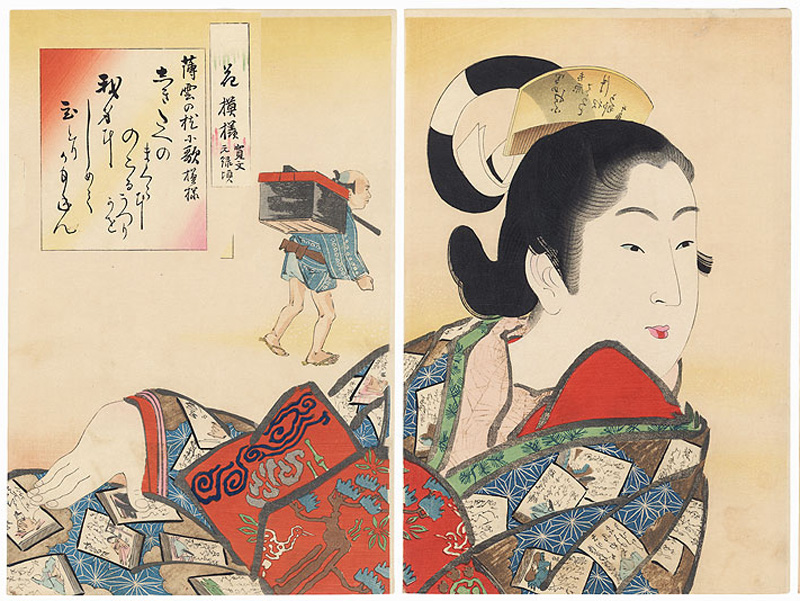
12 Die Genroku Zeit
Jukichi Inoue writes:
Some eighty years after the establishment of the Tokugawa Shogunate began the Genroku period. The Shogun at the time was the fourth of Iyeyasu’s line. No insurrection was feared at home and there was as little danger of the country’s isolation being disturbed by foreign invasion, for no foreigner was allowed to trade in Japan with the exception of the Dutch and Chinese, whose trade was confined to Nagasaki. The country, in short, enjoyed absolute peace and grew in wealth and prosperity.
Such was the condition of the land in the Genroku period, which takes its name from the Genroku era (1689-1701) and extended over some fifty years beginning with the Tenna era in 1681 and ending with the Kyoho era in about 1735. It was a period of great importance in the history of Japanese manners, institutions, and literature.
Genroku
The first years of the Tokugawa régime were a period of turbulent militarism and its last years that of indolence and immorality; in the Genroku period, however, the rough militaristic spirit was nearly gone, but the people had not yet fallen into weak and effeminate ways; luxury and extravagance had commenced their sway, but the brave military spirit had not yet vanished. It marked, like the Heian period of the ninth and tenth centuries, the highest stage of Japanese civilisation; and with the dark age of internecine wars intervening between these two periods, it was, indeed, our age of renaissance.
During this period, Bushido, in spite of some evils that attached to it, reached its highest level. This peculiar spirit of Japan had been influenced in the earlier ages by the doctrines of Buddhism; but coming under the influence of Confucianism when the Tokugawa family came into power, it became a cult of complete growth and took its final form early under the Tokugawa rule. But Bushido, like all other institutions, was bound to undergo changes as time went on. Under Shogun Iyetsuna (1650-1680), the fourth of the Tokugawa line, the old sturdy military spirit began to decline in Edo; and under his successor Tsunayoshi (1680-1709), the Genroku period came in with its love for luxurious living, display, and immorality, with the result that Bushido which had been developed to the highest degree among the warriors of the Eastern Provinces left Edo, the centre of those provinces, and sought refuge in the country, where it remained unimpaired among the simple samurai of the daimiates. The Ako vendetta was a striking instance of its hold upon the country samurai.
The changes of manners under the Tokugawa Shogunate spread as a rule from Edo to the provinces. But in the early years of that Shogunate Edo was not yet the centre of Japanese civilisation; for though it held the foremost position in military arts, it was in literature, art, and other things inferior to Kyoto and Osaka which were as cities far older. The Eastern Provinces changed their manners by imitating those of these two western cities. But the manners and customs of the latter cities were at the time almost directly opposite to those of Edo. They were soft, frivolous, and elegant to effeminacy; Kyoto had, since it became the capital of the country in 794, been the centre of Japanese civilisation, while Osaka which had been from the oldest times an important port for vessels sailing to and from the western provinces, became especially prosperous from the days of Hideyoshi the Taiko (1536-97); and while they had long lost the simplicity and straightforwardness of more primitive districts, they were less moved by a sense of honour, more impelled by desire for wealth, and became more and more luxurious as they advanced in civilisation, and naturally grew more fond of ostentation.
The characteristics of the Genroku period were then represented by the manners and tastes of Kyoto and Osaka. In that period, though Edo was firmly established as the political centre of the country, it had to import from Kyoto and Osaka their literature and customs, which were thereupon acclimatised in Edo.
The true Edo spirit and manners did not come into being until a century later, that is, the beginning of the nineteenth century.
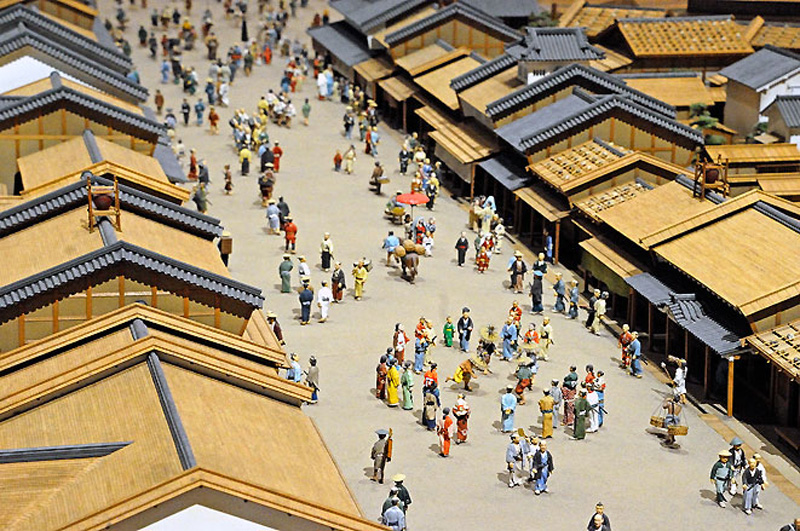
13 The merchant class
The centre of the literature and customs of Kyoto and Osaka was not, as in Edo, the samurai, but the merchant. The merchant who had, until a generation or two previously, been oppressed by class distinctions, came in the long period of peace to acquire wealth and extravagant habits as the standard of living rose. For as the means of transportation and communication developed, many of them made large fortunes by engaging in building and public works. There were not a few of these noted men of wealth in Osaka and Kyoto. In Osaka the world was the merchants’; and the samurai, however high he might hold up his head, had to yield in actual power to the common people.
As there were many wealthy men among the merchants who spent money freely, they were the best customers in theatres and in pleasure-quarters. The samurai, too, grew in time to envy the merchant’s popularity and began finally to imitate his ways. The manner in which Yuranosuke is drawn as a man about town in the seventh act of the Chushingura, may be due partly to the fact that the authors were all of the merchant class; but it also serves to show the general behaviour of samurai in pleasure-quarters.
14 THE PLEASURE-QUARTERS
But a merchant could only be a merchant; the strict social distinctions could no more than the hereditary character of family occupations be set aside. And the only place where the merchants could spend money lavishly without fear of the samurai and without distinction of classes, was the pleasure-quarters.
The attitude of the people of that time towards those quarters was different to the attitude of men of the present time. Love between the sexes was condemned by the moral teaching of the time; and it was not to be thought of that men and women should exchange love of their own free will. Not only women, but men, usually left entirely to their parents the arrangements for their marriages; and when the husband and wife lived together, they appeared to the world somewhat in the relations of master and servant, however much they might really love each other.
Some of Chikamatsu Monzaemon’s plays depict men and women freed from all trammels and indulging in unfettered love. These plays won the admiration and sympathy of the world because they were written with peculiar skill by their great author. But otherwise, the people of the period regarded such characters as being immoral and licentious; and while they pitied them for their sufferings, they condemned no less their lack of chastity.
In the pleasure-quarters was to be found a world free from social restraint and from fetters of morality, where could be seen women in their natural mood, untrammelled by restraints of any kind. These quarters were outlets for the depressed spirits caused by the pressure of the negative policy of the Tokugawa government, where all ranks and grades of society could associate freely and on equal terms. The quarters in Edo, Kyoto, and Osaka were frequent subjects of plays and novels of the time; indeed, it may be said that more than half the literature of the Genroku period was devoted to these quarters and their inhabitants.
A brief summary of the story of the 47 Rōnin
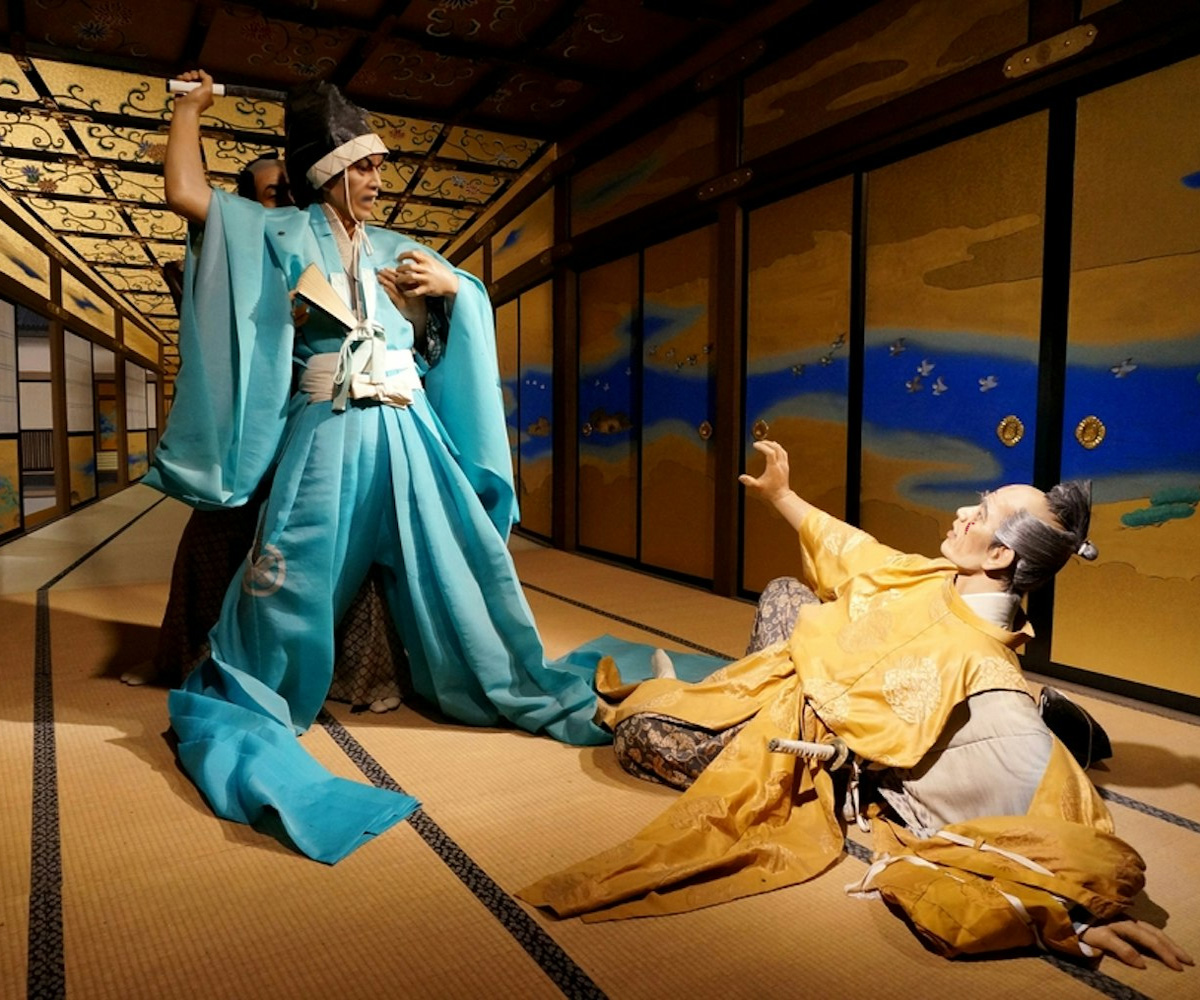
The trigger
In 1701, two daimyō were tasked with organising a reception ceremony at the shōgun’s court in Edo.
The two men, Kamei Korechika and Asano Naganori, were briefed by the master of ceremonies, Kira. Kira was very dissatisfied with the pair, allegedly because he had not received sufficient bribes from them.
The whole affair culminated in the Master of Ceremonies calling Daimyō Asano a ‘village idiot’, whereupon Asano attacked him with a dagger. Kira sustained a minor injury to his face, whilst Asano was subdued by the security guards.
Asano was forced to commit seppuku. His fiefdom of Akō in western Honshu fell to the Shōgun, and his approximately 300 retainers became rōnin.
Forty-seven of these rōnin planned a vendetta, even though it was forbidden in such circumstances. They went underground, laid false trails and prepared their revenge.
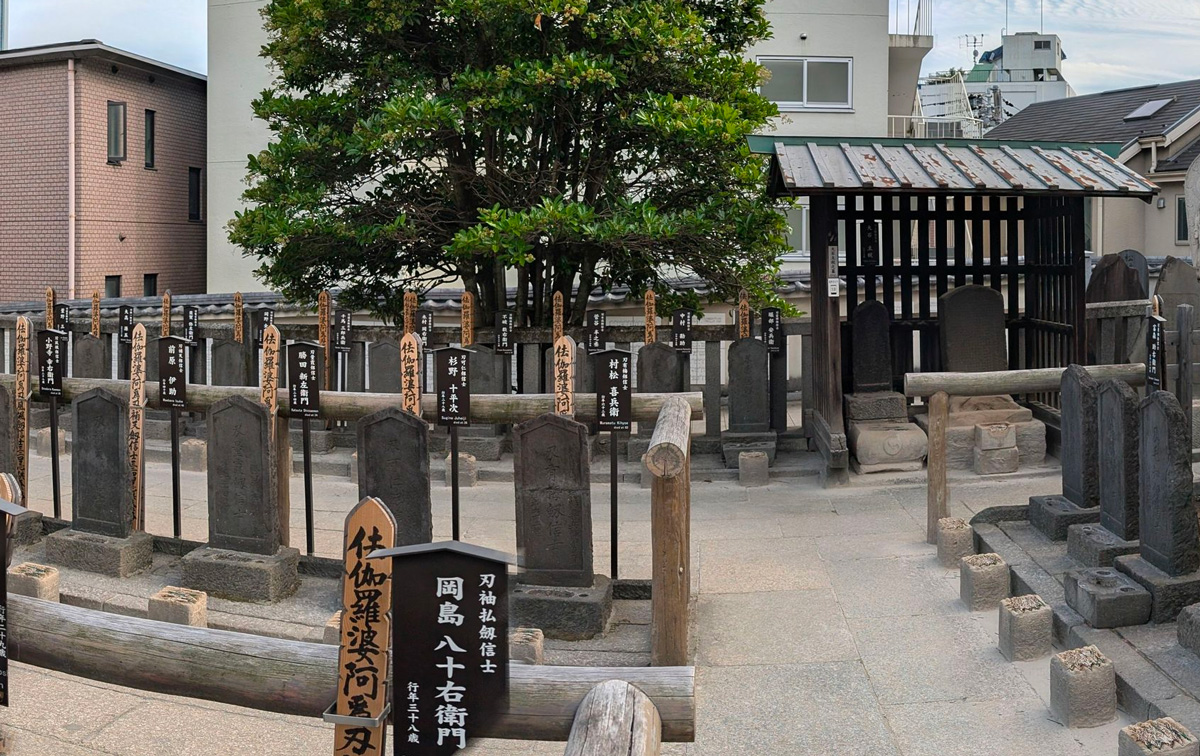
A view of the graves in the Sengaku-ji
2 Chome-11-1 Takanawa, Minato City, Tokyo 108-0074, Japan
The Vendetta
In 1703, the rōnin attacked Kira’s house, eventually found him in his hiding place and killed him. They took his head to their lord’s grave at Sengaku-ji Temple.
46 rōnin were sentenced to death by the shōgun and were permitted to commit seppuku. The 47th rōnin had been sent to Akō after the battle to report on the events. He was pardoned by the shōgun, allegedly because of his young age. He lived to the age of 78 and was then buried alongside his comrades at Sengaku-ji.
On the one hand, these events are regarded as a pure act of honour and loyalty. However, they were also motivated by specific reasons relating to the restoration of the Asano domain. With the death of their lord, hundreds of samurai had found themselves out of work, and for the most part they were unable to find new employment as they came from a disgraced house. Many were forced to eke out a living as farm labourers and day labourers. The revenge and the seppuku of the 47 rōnin cleared the house’s name, and many of the unemployed samurai found honourable employment again shortly after this honourable act of self-sacrifice.
Asano Naganori’s younger brother and heir was once again granted the fief by the Tokugawa shogunate, albeit comprising only a tenth of the formerly quite extensive territory.