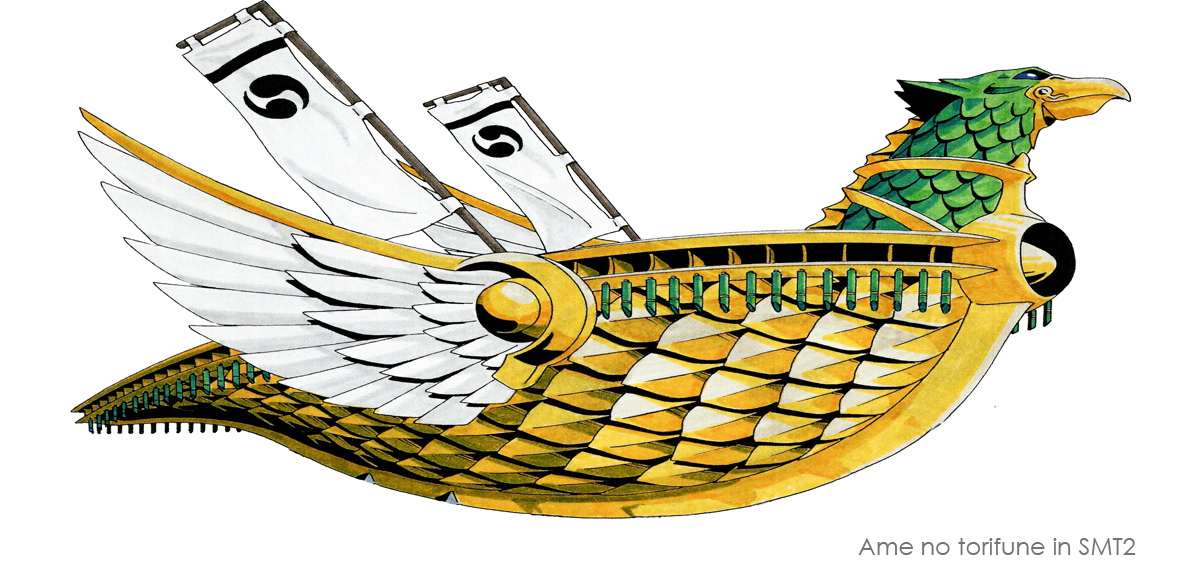
From Ame-no-torifune to funakogi

天の鳥船の行から船漕運動まで

Ame-no-torifune-no-gyō

Ame-no-torifune-no-gyō (天の鳥船の行) is a Shinto practice. The name Torifune ("Bird Boat") appears as early as the Kojiki (around 712 CE), one of the oldest chronicles of Japan. Ame no Torifune no kami is a deity who emerged from the creation couple Izanagi and Izanami.
In the myths, Ame no Torifune is both a "celestial bird boat" and a personification of this divine vessel, understood as a protective deity, especially for sea voyages. This likely reflects the central role of boats in the ancient island nation of Japan and perhaps also the fact that Japan was settled by sea.
In Shinto practice, Torifune is used as a ritual rowing motion (funakogi), primarily in the context of misogi. The rhythmic movement is intended to harmonize breath, body, and mind, preparing them for approaching the Kami. Later, Torifune, together with Furitama (shaking the hands folded in front of the Hara), serves as a means of activating Ki and focusing consciousness within the Hara.

Traditional form

The video shows the entire Shinto exercise. It includes invocations of the gods, rowing movements accompanied by different sounds, misogi with cold water, and one-handed cutting movements. The entire sequence is also known as Chinkon kishin (鎮魂帰神). The first part of the term, chinkon (鎮魂), means “to calm or settle the spirit." It is similar in meaning to “unify” [toitsu]. You concentrate, or unify, your feelings, thoughts, and spirit. Kishin (帰神) means “to return to kami.” You unify your spirit with Great Nature, with everything.
The filming took place in January 2018 at the Sakae no Yashiro Shrine in the city of Fukui. Fukui-shi is located in western Japan on the coast and has a sister city relationship with, among others, Winsen an der Luhe (south of Hamburg).

In Aikido

Shirakawa Katsutoshi (born 1946) is a Shihan of Aikido and a Shinto priest. Here he demonstrates the entire sequence without water misogi, including invocation of the gods, furitama (vibrating the hands in front of the center), cutting, and breathing exercises at the end. Similar sequences are regularly practiced at the beginning of training in several Aikido styles.
Shirakawa Katsutoshi is the father of Shirakawa Ryuji (born 1980), a young Aikido Shihan who is also well-known on YouTube.

Explanations

In the book "Journey to the Heart of Aikido", Motomichi Anno (*1931) explains how he himself understands this exercise.

The Practice of Torifune
I believe torifune [“the rowing exercise"] has been practiced in Japan since ancient times, but there is still little understanding of its importance. You could say that torifune is the foundation of movement and technique. When we practice torifune, we train our hearts and our bodies. We breathe well and become more healthy. Torifune develops your ability to transfer weight, to turn the hips, and it cultivates kokyu ryoku: breath power. The “Ei-ho, Ei-ho” sound we do with the movement of torifune also cultivates breath power.
The essence of the torifune practice is the breath. Breathing out, and breathing in, while strengthening and stabilizing the hips. “Breath power” is more than your own individual breath. O-Sensei’s teaching was about becoming one with kami - one with nature. You can cultivate breath power in conjunction with others, and with Nature. When you breathe in, you absorb everything. You become one. Then you exhale with a feeling of love. This feeling, of love for everything, is the foundation.
Whether you are inhaling or exhaling, ultimately it is the same feeling: gratitude. Isn't it natural to feel thankful as you absorb all the wonders of the universe? And as you return, with the out-breath, all that you have received, that is also a feeling of gratitude.
The most important thing is the state of one's spirit. I feel that my spirit resides in the center of my hara [belly]. The navel is where we were all originally connected to our mothers. It is the place of origin, the source of my life; I feel it as my center. My intention is to become one body with nature, with the universe, with kami.

Ueshiba

Excerpts from filmings at the Hombu Dojo from the 1960s.
While Ueshiba Morihei performs the exercises in a more upright posture, Ueshiba Kisshomaru traditionally bends downwards.
“Aikido is misogi, purification of body and mind, a way to reform and transform the world. I show my techniques to encourage those of little faith." (Ueshiba Morihei)

Tohei Koichi

Tohei Koichi uses the exercise as gymnastic preparation for Aikido techniques. He writes in his book "Aikido the Arts of Self-Defense":

… take half a step forward with your left foot …
At count One, push your koshi (hip) forward as though to push your one point forward horizontally and thrust your arms forward forcefully, keeping the wrists bent. The upper body is kept vertical, bending neither forward nor backward. The arms are not thrust forward so much as brought forward with the feeling of extending Ki from the koshi. The right leg should be stretched easily to the rear.
At count Two, draw back your koshi, at the same time pulling back your wrists to your hips. It should be a pulling back with the koshi and not a pulling back with the arms. The right leg then is slightly bent and the left leg is straightened.
Bear in mind that this exercise is more for the koshi than for the arms.

Yoshigasaki 2019

Yoshigasaki Sensei teaches a completely different form than the one we have seen above, obviously adapted to the partner exercise in which Uke restrains Nage's wrists.
Rhythm 1 begins with the arms already slightly extended. The hands move forward and then arc upwards on the return journey. Rhythm 1 ends at the highest point.
In Rhythm 2, the hands swing downwards to the hips and then upwards and forwards. Rhythm 2 ends there.
From this point on, Uke should no longer resist. The hands move slightly forwards, and only then does Rhythm 1 begin again.
Yoshigasaki Sensei considers the rather mechanical rhythm, which ends at the furthest point forward in Rhythm 1 and at the hips in Rhythm 2, to be point mathematics. The form he proposes follows the mathematics of forms.