Japanese multiplication

a graphical method

For some time now, the "Japanese method of multiplication" has been promoted on internet. It works by drawing lines that intersect and then calculating the number of intersection points. (The images above show other historical methods of calculation.)

The diagram

(Note: The lines are usually drawn diagonally. However, it is more comprehensive to use horizontal and vertical lines.)
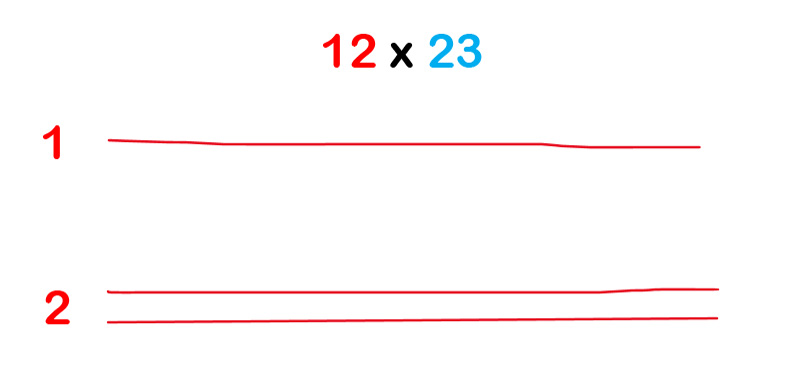
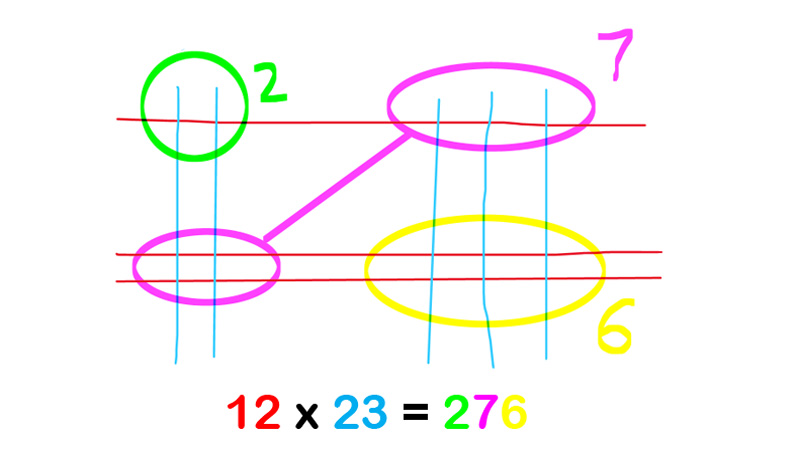
For the calculation 12 x 23, draw the lines for the first number 12 horizontally: 1 line and 2 lines.

In the diagram shown here, the number is drawn from left to right. In other words, you start at the top with the highest power of ten and then continue with the others.
In general, two-digit numbers with low digits are usually chosen for the examples. In these cases, the results appear very direct and obvious.


The second number

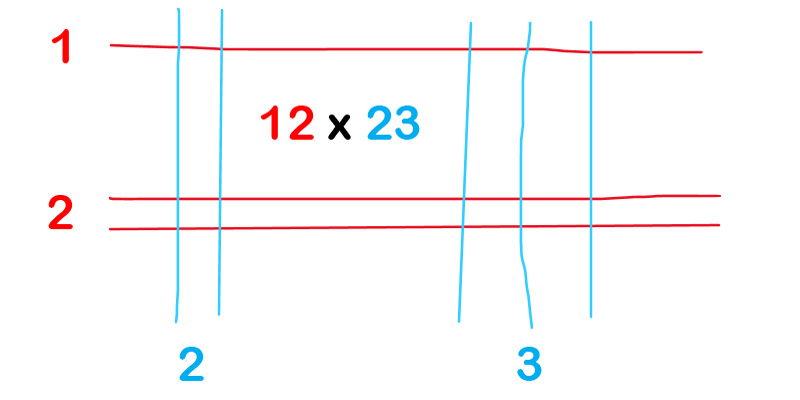
For the second number 23, draw the corresponding lines vertically and from left to right: 2 lines and 3 lines.
This gives you a graphical representation of the product.

Counting the intersections

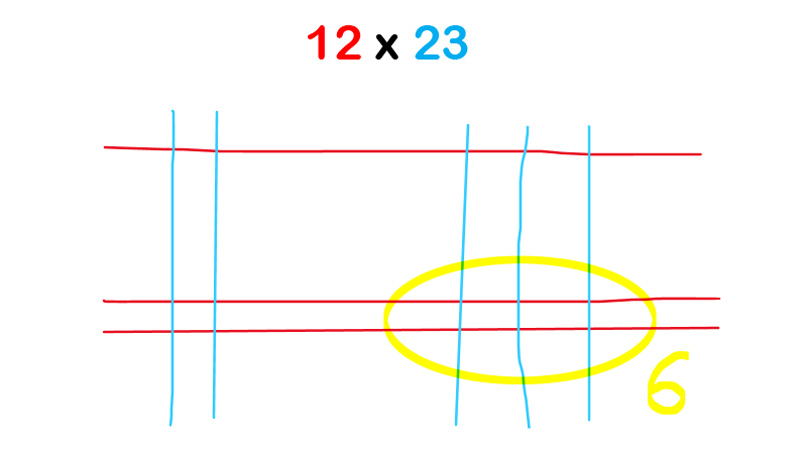
If you have chosen the representation described above – from top to bottom and from left to right – the counting starts at the bottom right.

In this example, there are 6 intersections.

Counting the other intersections

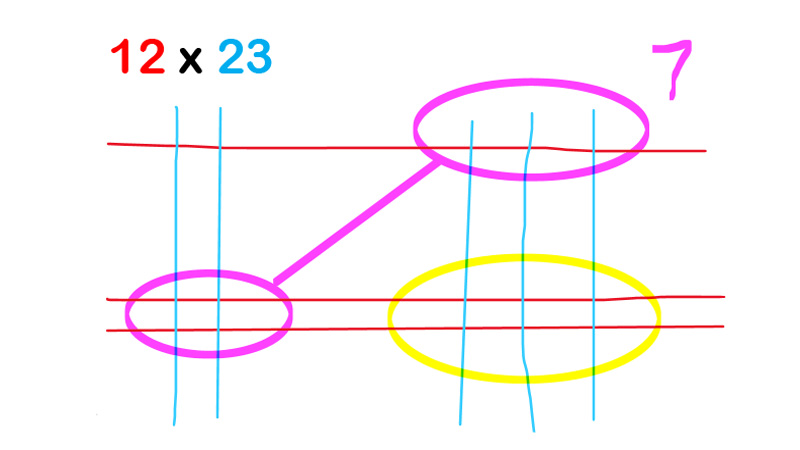
From these first intersections, move to the next intersections, both upwards and to the left. These must be added together.

In our case, there are 7 intersections.

Result

This process is continued until the complete graphic of the multiplication is obtained.

The result can be read directly from this simple example: 276

Mysticism?

At first glance, this drawing method may seem puzzling. Is it East Asian mysticism?
However, using single-digit numbers as an example, the essence of the method becomes immediately apparent: three lines intersect two other lines exactly six times. This is a graphical representation of the product 3 x 2.
For multi-digit numbers, the groups of intersections must be correctly combined diagonally.

A more complex example

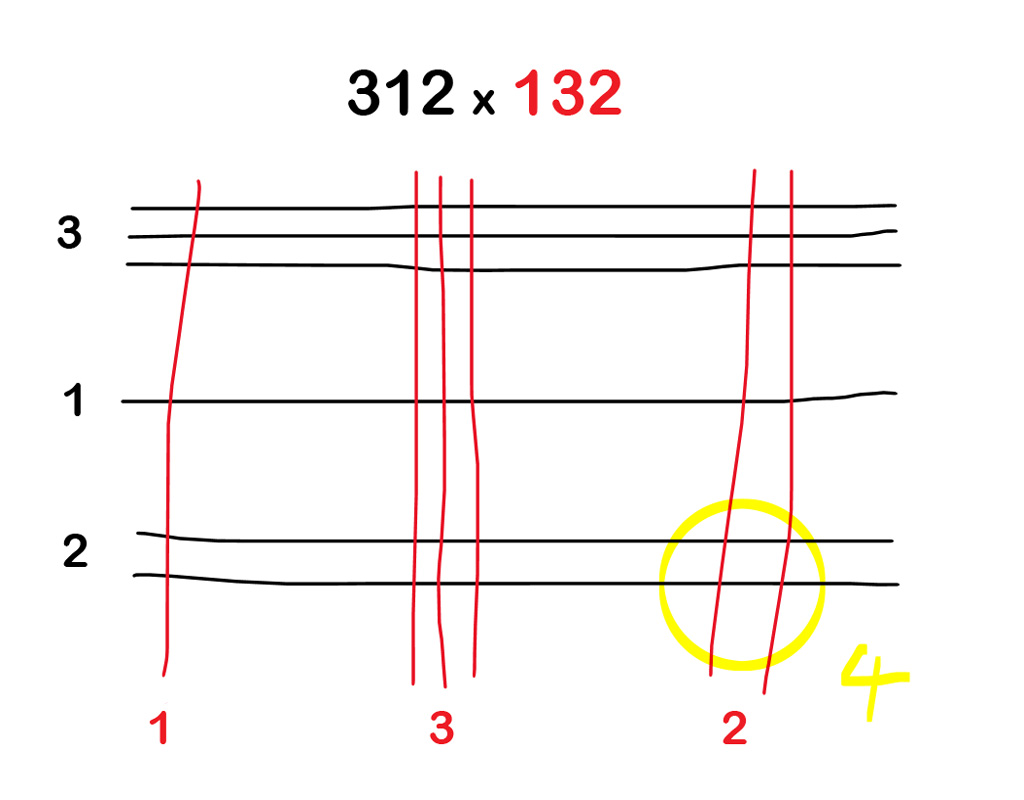
The product 312 x 132 requires more lines, cannot be read immediately and requires intermediate calculation steps.

First, the lines for the first number are drawn again: 3 lines, 1 line and 2 lines. Horizontally and from top to bottom.
Then the lines for the second number are drawn: 1 line, 3 lines and 2 lines. Vertically and from left to right.

Counting the intersections starts again in the bottom right-hand corner.

Correct finding

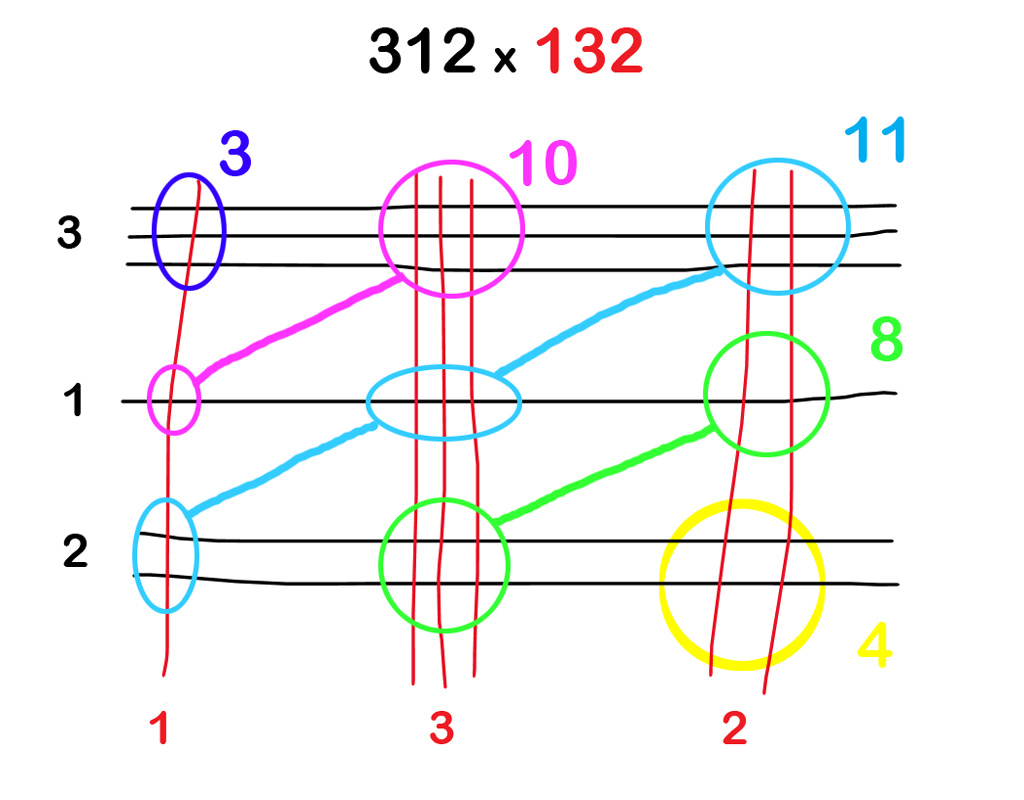
To find the sum of the intersections for the different powers of ten, move on to the next intersection group. More precisely, mark all the next neighbours of the last marked intersection groups that have not yet been marked. They form a diagonal. The total number of intersections on the diagonal is noted.
Continue in this way until you reach the top left corner.

Correct addition

When the intermediate results are no longer single digits, the problem of carrying occurs during addition. There may be a graphical method for addition as well, but a little mental arithmetic is not a bad thing either.

Written multiplication

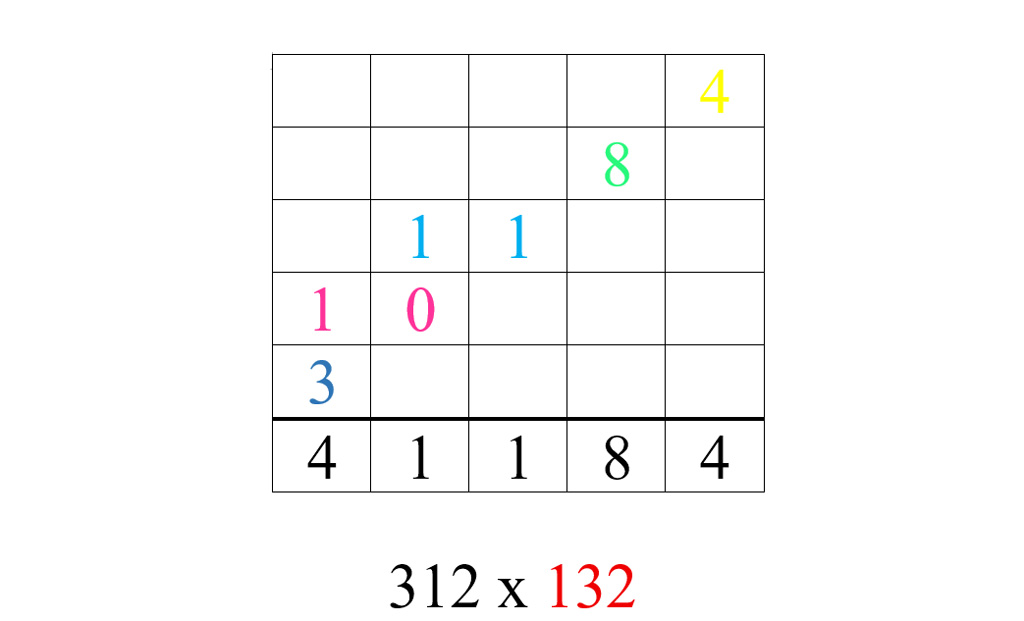
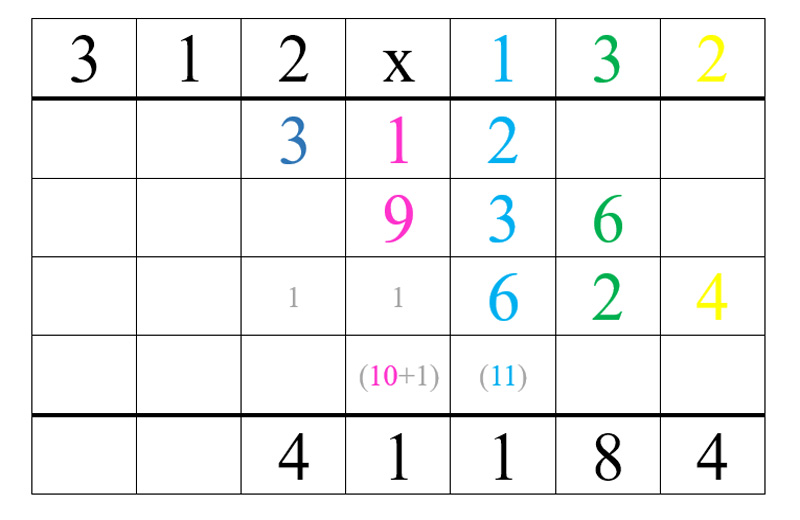
For comparison, here is the diagram used for written multiplication.
What are the differences compared to the Japanese graphical method?
The graphical method is suitable for small numbers with low digits. There is no need to ‘calculate’. It is sufficient to count the intersections. For larger numbers, the drawing must be well organised so that the connected diagonals are marked correctly. When crossing tens, you have to calculate in your head again or write everything down. When multiplying in writing, you need to know the multiplication table from 1x1 to 9x9 by heart. The tens must be carried over correctly.

Sangaku

Sangaku (算額, arithmetic pictures) are artistically painted wooden panels depicting geometric problems or puzzles. They were hung in Shinto shrines and Buddhist temples throughout Japan during the Edo period (1603–1867) by members of all social classes. There they served as offerings and as intellectual challenges for subsequent pilgrims.
The clip shows an excerpt from the 2012 film ‘Tenchi meisatsu’.